SOUL OVER STREAMS: Why O.M.V.M. Chose Art Over Algorithms

In a music culture built around dashboards, viral clips, playlist placement, and daily numbers, O.M.V.M. asks a different question:
What is the music actually saying?
That question sits at the center of SOUL OVER STREAMS, the album by O.M.V.M. (Oak Cliff’s Most Vicious MCs): STBMAN STBERNARD, QUEELA-BEELA, and GREAT DANE. Released on Bandcamp on July 9, 2026, the project is a direct statement from an independent group based in Oak Cliff, Dallas.
The title is more than a slogan. It is a creative position.
For O.M.V.M., music is not only about how many times a track gets played. It is about whether a song has identity, whether the words carry weight, and whether the listener can feel a human being behind the performance.
That is the idea behind soul over streams.
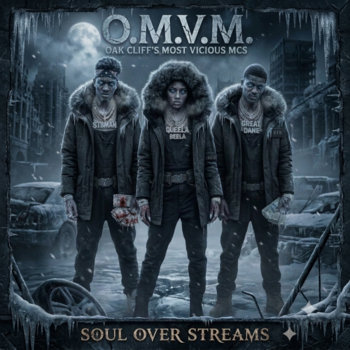
What does “soul over streams” mean?
The phrase does not mean O.M.V.M. is against listeners, growth, or people discovering their music. It means numbers are not the only measure of value.
A stream can tell you that a song was played. It cannot fully explain what that song meant to someone, whether it helped a listener through a hard night, or whether its message stayed with them after the music stopped.
That distinction matters to O.M.V.M. because SOUL OVER STREAMS is built around ideas that are difficult to reduce to a statistic: authenticity, legacy, social awareness, family, loyalty, love, and the difference between lived experience and performance.
The album’s Bandcamp description frames it as a project that confronts fake, lazy, and copy-and-paste music culture while holding onto lyricism, cinematic feeling, emotional honesty, and clean songwriting. It is presented as trap-soul, hardcore hip-hop, conscious trap, and Southern storytelling: but the larger identity is personal.
This is music from Oak Cliff, Dallas, made to sound like it has somewhere to come from.
An independent music statement from Oak Cliff
Independent music gives artists room to define their own priorities. Without needing to follow a major-label template, an independent artist can make a project that is stranger, more direct, more personal, or more focused on long-term identity than short-term attention.
That freedom is important to SOUL OVER STREAMS.
O.M.V.M. does not present itself as a group trying to blend into a trend. The three members bring distinct roles to the project. STBMAN STBERNARD often carries the polished, ambitious, and visionary energy. QUEELA-BEELA brings emotional intelligence, melody, and a sharp perspective on identity and vulnerability. GREAT DANE brings a heavier, observant, and disciplined presence.
Together, they create an album that feels less like a collection of unrelated singles and more like a conversation about what music should be allowed to do.
It can challenge the culture. It can tell the truth. It can expose a false image. It can still care about the people listening.
Calling out copy-and-paste culture
Several tracks make the album’s central conflict clear.
“AUTOTUNE ADDICTION” challenges robotic performances and emotionless delivery. “COPY & PASTE” attacks cloned identities, borrowed aesthetics, and trend addiction. “NO SOUL IN THE BOOTH” points directly at the emptiness that can appear when technique and image replace meaning.
These songs are not simply complaints about technology or musical change. The deeper issue is imitation without identity.
O.M.V.M. is not saying that every modern tool is automatically bad. The group’s broader creative world includes AI-powered entertainment, AI music videos, original characters, stories, and visual media. The point is that technology should serve creativity: not replace the need for a point of view.
An effect can change a voice. It cannot create a life story.
A visual filter can change an image. It cannot create character.
An algorithm can recommend a song. It cannot decide whether the song has something real to say.

Why “WE STILL WRITE” matters
The track “WE STILL WRITE” may be the clearest summary of the album’s philosophy.
Writing takes time. It asks artists to sit with an emotion, find the right words, and make choices that cannot always be predicted by a trend report. It values the verse, the story, the detail, and the feeling behind the line.
That approach matters because quick attention can encourage quick creation. When artists feel pressured to make everything instantly understandable, instantly shareable, or instantly viral, the work can lose its patience.
O.M.V.M. chooses to protect the part of music that takes longer.
The group’s idea of storytelling is not limited to autobiography. It also includes social consciousness. SOUL OVER STREAMS looks toward broken systems, worker empowerment, anti-war ideas, family, love, loyalty, and the consequences of teaching people to value appearances over character.
That is why the album’s message reaches beyond music-industry criticism. It asks what happens when people are trained to chase the image of success instead of building a meaningful life.
Real pain does not need a trend
“THEY SCARED OF TALENT” and “RENTED RICH” continue the album’s examination of image, status, and authenticity.
“THEY SCARED OF TALENT” presents originality as something that cannot be safely controlled. Real creative identity can disrupt comfortable formulas. It can make imitation obvious. It can remind listeners that popularity and artistry are not always the same thing.
“RENTED RICH” turns its attention toward borrowed luxury and staged success. Its target is not ambition itself. The target is the performance of wealth without the substance behind it.
That idea connects to “REAL PAIN DON’T TREND,” which questions a culture that can reward spectacle while overlooking quiet suffering. The track points toward the people whose struggles do not become public content: workers, parents, families, and individuals dealing with pressure away from the camera.
For O.M.V.M., art has value when it notices those people.
The album as a longer conversation
The title SOUL OVER STREAMS creates a useful tension. O.M.V.M. releases music into the same digital environment it critiques. The album lives on Bandcamp, where listeners can stream it and download it. The group uses social media to connect with its audience. Digital tools are part of the process.
The difference is what those tools are being used for.
They can become shortcuts that flatten identity: or they can help independent artists build a world around their work. They can encourage imitation: or make it easier for a creator to share something original. They can turn music into disposable content: or help a listener find a project that deserves a full listen.
O.M.V.M. chooses the second possibility.
That choice also connects to the group’s visual ambitions. STBVERSE is developing an interconnected entertainment universe that combines music, storytelling, fictional characters, films, series, games, and AI-powered visual entertainment. In that larger world, a song is not just an isolated upload. It can be part of a growing creative language.
The goal is not to reject the future. It is to enter the future without abandoning the human reason for making art in the first place.
Why this album matters now
The conversation around algorithms is often framed as a technical problem: how to reach more people, increase engagement, or improve discoverability.
But SOUL OVER STREAMS frames it as a values problem.
What are artists willing to sacrifice for attention?
Will they change their voice until it sounds like everyone else? Will they hide vulnerability because it does not look powerful? Will they create only what performs quickly? Will they measure their worth by numbers that can rise and fall overnight?
O.M.V.M.’s answer is clear: numbers may be part of the music business, but they should not become the soul of the music.
A song can be successful because it makes a listener think. Because it tells the truth. Because it gives language to pain. Because it honors family. Because it challenges a broken system. Because it sounds like nobody else.
That is the standard O.M.V.M. brings to SOUL OVER STREAMS.
Hear the album for yourself
If you want to understand the idea of soul over streams, do not take the phrase as a press statement. Hear how O.M.V.M. builds the argument across the album: from “AUTOTUNE ADDICTION” and “COPY & PASTE” to “THEY SCARED OF TALENT,” “NO SOUL IN THE BOOTH,” “RENTED RICH,” “WE STILL WRITE,” and “FOUNDATIONS (250 YEARS STRONG).”
Stream or download SOUL OVER STREAMS on Bandcamp.
Then follow O.M.V.M. on Instagram at @oak_cliffs_most_vicious_mcs for music, visuals, and updates from Oak Cliff’s Most Vicious MCs.
Because streams can count a play.
But soul is what makes the play worth remembering.